
It is all those things, but it’s also like show business, a play staged every day with a bit of illusion and talented actors dealing directly with an audience of guests.
If they can open the doors and turn on the lights, it must go on, despite all the backstage stuff that might be trying to darken it: fights over money, changes in management, legal struggles over ownership, loss of a prestigious “flag,” an uncertain future.
That’s what happened at The Cornhusker Marriott, climaxing in 2012, when the troubled and disruptive eight-year ownership by Atul Bisaria and his Shubh Hotels finally came to an end.
A year ago, things couldn’t have looked much worse, as Bisaria’s properties elsewhere were going out of business, The Cornhusker was being repossessed and it was losing its prestigious Marriott affiliation, because it wasn’t up to those standards. That meant an immediate loss of business. Nobody was telling the frightened employees anything. Some of them bailed out.
But a group who hung in there through it all talked recently about the experience, no less than a cliffhanger, as they basked in the probability of a long run under the new ownership of LEM Capital and partner Marcus Hotels and Resorts, which owns the bigger share and plans millions of dollars in overdue renovations.
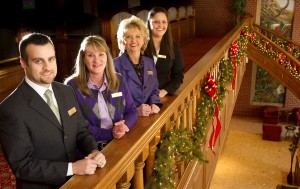
The Marriott affiliation restored, Marcus gives these people credit for keeping the show together. They include Julie Campbell, director of sales; Dan Jones, senior sales manager; Karen Criss, banquet manager; Cindy Choma, accounts payable supervisor; and Freddie Lozano, bellman.
Lozano, on the front lines of service, has seen more of the hotel’s history than most. He has worked there for 12 years, through part of investor David Murdock’s ownership, then under Bisaria’s and now with Marcus.
The past year was tough.
“We didn’t know much, nobody told us anything, it felt like we were left in the dark,” he said. “Every day you’d hear a different rumor. There was a lot of uncertainty and a lot of worried people. We heard this place might close. We didn’t know what to believe. We were just hoping something positive would happen.
“When we lost the (Marriott) flag, it got really bad,” Lozano said. “People started to quit, you know, managers who said, ‘We better leave before the ship sinks.’ It was really bad for the employees. It was a dark time.
“We did our best, but we could tell the hotel was going downhill. When we lost our flag, we didn’t have as much business, occupancy went down, we lost all those Marriott people. It was tough for people who depend on tips, bell service, the restaurant. We weren’t making as much money, and we didn’t have the business.
“It was scary because we didn’t know what was going to happen to our hotel. Some (employees) had been here 20 or 30 years. You didn’t know what to believe. I just tried to stay positive and provide great service and hope we’d be bought by someone who’d bring back the hotel to what it was before, or better.”
Spoken as if he wrote the play. Which brings up the part about illusion.
“It was rough, but we, of course, didn’t let the guests know,” Jones said.
There were times, Cindy Choma acknowledged, when she didn’t know whether the bills would get paid.
“We improvised,” Campbell said. “We wanted new linen … so we figured out how to rent linen. We made lemonade.”
“We became professional problem-solvers,” Criss said. “When you gotta put the show on, you take care of it.”
They became better managers, better people, worked better as a team, they said, and reassured skeptical customers who knew something was amiss.
“They questioned how stable the hotel was,” Jones said. “We assured them they’d still get the same service.”
People advised Choma to get another job. Jones got a couple of calls about employment; he responded that he needed to see this thing out. Lozano thought about it but didn’t make out any applications.
Then in the spring came the Marcus rumors. Site inspections.
“When Marcus came in, word got out,” Campbell said. “People were saying, ‘We want Marcus!'”
The company has a name for reviving hotels that were in a lot worse shape than The Cornhusker was. One in Oklahoma City was boarded up.
In June, The Cornhusker had three national gatherings: the Congress of American Indians, adjutants general and Izaak Walton League.
“It was a great summer,” Campbell said. And in September came the news Marcus was taking over.
Morale was back; the gusto of a well-rehearsed show was there. Then came Marriott’s return and the beginning of renovations.
Now all the guest rooms have new linen. And it’s not rented. New china, glass and silver.
They are working on increasing bandwidth and making The Cornhusker Marriott the most tech-friendly hotel in the state, Campbell said. More ports, all-new computers for the staff who use them.
“A lot of back-of-the-house stuff,” said Jones. Those things the audience doesn’t see. In two weeks, they got 20 new requests for proposals for big gatherings.
The new decorating will be as obvious as a new chandelier. Not so for some other system renovations. Hotel systems have a six-year to seven-year life cycle. This one is a little past that.
There were times during the past year when new management companies were announced but never arrived.
Now it’s clear who’s running things. “Marcus is right here with us,” Choma said.
“They have a huge support team,” Campbell said. “It’s a blessing.”
The voices that answer the phone make it sound like a musical.
“Right now, it’s during our slow season, but things are going great,” Lozano said. “We’re like a family again. We’re all on the same page, we know what’s gonna happen and so everything’s looking really positive. I’m just looking forward to being the best hotel in Lincoln and probably Nebraska when they’re finished with everything. With the best service.”